
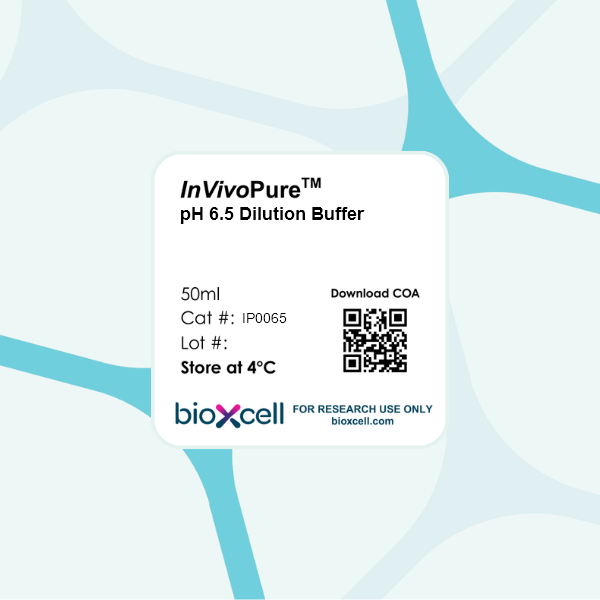
InVivoPure pH 6.5 Dilution Buffer
Product Description
Specifications
| Endotoxin |
<0.5 EU/mL (<0.0005EU/μL) Endotoxin level is determined using an LAL gel clotting test |
|---|---|
| Sterility | 0.2 μM filtered |
| Murine Pathogen Tests |
Mouse Norovirus: Negative Mouse Parvovirus: Negative Mouse Minute Virus: Negative Mouse Hepatitis Virus: Negative Reovirus Screen: Negative Lymphocytic Choriomeningitis virus: Negative Lactate Dehydrogenase-Elevating Virus: Negative Mouse Rotavirus: Negative Theiler’s Murine Encephalomyelitis: Negative Ectromelia/Mousepox Virus: Negative Hantavirus: Negative Polyoma Virus: Negative Mouse Adenovirus: Negative Sendai Virus: Negative Mycoplasma Pulmonis: Negative Pneumonia Virus of Mice: Negative Mouse Cytomegalovirus: Negative K Virus: Negative |
| Toxicity Test Results | Nontoxic and nonantigenic in animal models |
| Concentration | 1X |
| Volume | 50 ml |
| Composition |
16 mM Na2HPO4 23 mM NaH2PO4 136 mM NaCl This buffer does not contain calcium, magnesium, phenol red, or preservatives such as azide. Keep contents sterile. Open only in a biological safety cabinet. |
| Storage | 4°C |
Product Citations
-
-
Immunology and Microbiology
PVRL2 Suppresses Antitumor Immunity through PVRIG- and TIGIT-independent Pathways.
In Cancer Immunology Research on 2 May 2024 by Yang, J., Wang, L., et al.
Poliovirus receptor-related 2 (PVRL2, also known as nectin-2 or CD112) is believed to act as an immune checkpoint protein in cancer; however, most insight into its role is inferred from studies on its known receptor, poliovirus receptor (PVR)-related immunoglobulin domain protein (PVRIG, also known as CD112R). Here, we study PVRL2 itself. PVRL2 levels were found to be high in tumor cells and tumor-derived exosomes. Deletion of PVRL2 in multiple syngeneic mouse models of cancer showed a dramatic reduction in tumor growth that was immune dependent. This effect was even greater than that seen with deletion of PD-L1. PVRL2 was shown to function by suppressing CD8+ T and natural killer cells in the tumor microenvironment. The loss of PVRL2 suppressed tumor growth even in the absence of PVRIG. In contrast, PVRIG loss showed no additive effect in the absence of PVRL2. T-cell immunoreceptor with Ig and ITIM domains (TIGIT) blockade combined with PVRL2 deletion resulted in a near complete block in tumor growth. This effect was not recapitulated by the combined deletion of PVRL2 with its paralog, PVR, which is the ligand for TIGIT. These data uncover PVRL2 as a distinct inhibitor of the antitumor immune response with functions beyond that of its known receptor PVRIG. Moreover, the data provide a strong rationale for combinatorial targeting of PVRL2 and TIGIT for cancer immunotherapy. ©2024 The Authors; Published by the American Association for Cancer Research.
-
-
-
Immunology and Microbiology
PVRL2 Suppresses Antitumor Immunity through PVRIG- and TIGIT-independent Pathways.
In Cancer Immunology Research on 2 May 2024 by Yang, J., Wang, L., et al.
Poliovirus receptor-related 2 (PVRL2, also known as nectin-2 or CD112) is believed to act as an immune checkpoint protein in cancer; however, most insight into its role is inferred from studies on its known receptor, poliovirus receptor (PVR)-related immunoglobulin domain protein (PVRIG, also known as CD112R). Here, we study PVRL2 itself. PVRL2 levels were found to be high in tumor cells and tumor-derived exosomes. Deletion of PVRL2 in multiple syngeneic mouse models of cancer showed a dramatic reduction in tumor growth that was immune dependent. This effect was even greater than that seen with deletion of PD-L1. PVRL2 was shown to function by suppressing CD8+ T and natural killer cells in the tumor microenvironment. The loss of PVRL2 suppressed tumor growth even in the absence of PVRIG. In contrast, PVRIG loss showed no additive effect in the absence of PVRL2. T-cell immunoreceptor with Ig and ITIM domains (TIGIT) blockade combined with PVRL2 deletion resulted in a near complete block in tumor growth. This effect was not recapitulated by the combined deletion of PVRL2 with its paralog, PVR, which is the ligand for TIGIT. These data uncover PVRL2 as a distinct inhibitor of the antitumor immune response with functions beyond that of its known receptor PVRIG. Moreover, the data provide a strong rationale for combinatorial targeting of PVRL2 and TIGIT for cancer immunotherapy. ©2024 The Authors; Published by the American Association for Cancer Research.
-