
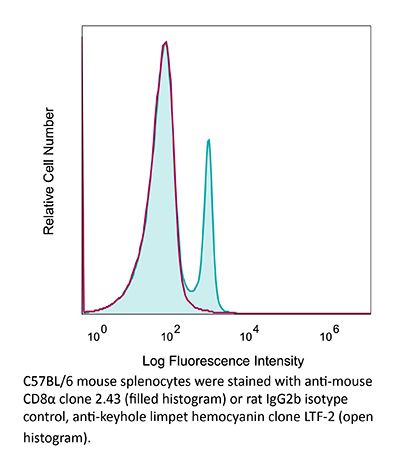
InVivoPlus anti-mouse CD8α
Product Description
Specifications
| Isotype | Rat IgG2b, κ |
|---|---|
| Recommended Isotype Control(s) | InVivoPlus rat IgG2b isotype control, anti-keyhole limpet hemocyanin |
| Recommended Dilution Buffer | InVivoPure pH 7.0 Dilution Buffer |
| Conjugation | This product is unconjugated. Conjugation is available via our Antibody Conjugation Services. |
| Immunogen | Mouse CTL clone L3 |
| Reported Applications |
in vivo CD8+ T cell depletion Western blot |
| Formulation |
PBS, pH 7.0 Contains no stabilizers or preservatives |
| Endotoxin* |
≤0.5EU/mg (≤0.0005EU/μg) Determined by LAL assay |
| Aggregation* | <5%, Determined by SEC |
| Purity |
≥95% Determined by SDS-PAGE |
| Sterility | 0.2 µm filtration |
| Production | Purified from cell culture supernatant in an animal-free facility |
| Purification | Protein G |
| RRID | AB_1125541 |
| Molecular Weight | 150 kDa |
| Murine Pathogen Tests* |
Ectromelia/Mousepox Virus: Negative Hantavirus: Negative K Virus: Negative Lactate Dehydrogenase-Elevating Virus: Negative Lymphocytic Choriomeningitis virus: Negative Mouse Adenovirus: Negative Mouse Cytomegalovirus: Negative Mouse Hepatitis Virus: Negative Mouse Minute Virus: Negative Mouse Norovirus: Negative Mouse Parvovirus: Negative Mouse Rotavirus: Negative Mycoplasma Pulmonis: Negative Pneumonia Virus of Mice: Negative Polyoma Virus: Negative Reovirus Screen: Negative Sendai Virus: Negative Theiler’s Murine Encephalomyelitis: Negative |
| Storage | The antibody solution should be stored at the stock concentration at 4°C. Do not freeze. |
| Need a Custom Formulation? | See All Antibody Customization Options |
Application References
-
Coffelt, S. B., et al (2015). "IL-17-producing gammadelta T cells and neutrophils conspire to promote breast cancer metastasis" Nature 522(7556): 345-348.
PubMed
Metastatic disease remains the primary cause of death for patients with breast cancer. The different steps of the metastatic cascade rely on reciprocal interactions between cancer cells and their microenvironment. Within this local microenvironment and in distant organs, immune cells and their mediators are known to facilitate metastasis formation. However, the precise contribution of tumour-induced systemic inflammation to metastasis and the mechanisms regulating systemic inflammation are poorly understood. Here we show that tumours maximize their chance of metastasizing by evoking a systemic inflammatory cascade in mouse models of spontaneous breast cancer metastasis. We mechanistically demonstrate that interleukin (IL)-1beta elicits IL-17 expression from gamma delta (gammadelta) T cells, resulting in systemic, granulocyte colony-stimulating factor (G-CSF)-dependent expansion and polarization of neutrophils in mice bearing mammary tumours. Tumour-induced neutrophils acquire the ability to suppress cytotoxic T lymphocytes carrying the CD8 antigen, which limit the establishment of metastases. Neutralization of IL-17 or G-CSF and absence of gammadelta T cells prevents neutrophil accumulation and downregulates the T-cell-suppressive phenotype of neutrophils. Moreover, the absence of gammadelta T cells or neutrophils profoundly reduces pulmonary and lymph node metastases without influencing primary tumour progression. Our data indicate that targeting this novel cancer-cell-initiated domino effect within the immune system–the gammadelta T cell/IL-17/neutrophil axis–represents a new strategy to inhibit metastatic disease.
-
Yamada, D. H., et al (2015). "Suppression of Fcgamma-receptor-mediated antibody effector function during persistent viral infection" Immunity 42(2): 379-390.
PubMed
Understanding how viruses subvert host immunity and persist is essential for developing strategies to eliminate infection. T cell exhaustion during chronic viral infection is well described, but effects on antibody-mediated effector activity are unclear. Herein, we show that increased amounts of immune complexes generated in mice persistently infected with lymphocytic choriomeningitis virus (LCMV) suppressed multiple Fcgamma-receptor (FcgammaR) functions. The high amounts of immune complexes suppressed antibody-mediated cell depletion, therapeutic antibody-killing of LCMV infected cells and human CD20-expressing tumors, as well as reduced immune complex-mediated cross-presentation to T cells. Suppression of FcgammaR activity was not due to inhibitory FcgammaRs or high concentrations of free antibody, and proper FcgammaR functions were restored when persistently infected mice specifically lacked immune complexes. Thus, we identify a mechanism of immunosuppression during viral persistence with implications for understanding effective antibody activity aimed at pathogen control.
-
Kearl, T. J., et al (2013). "Programmed death receptor-1/programmed death receptor ligand-1 blockade after transient lymphodepletion to treat myeloma" J Immunol 190(11): 5620-5628.
PubMed
Early phase clinical trials targeting the programmed death receptor-1/ligand-1 (PD-1/PD-L1) pathway to overcome tumor-mediated immunosuppression have reported promising results for a variety of cancers. This pathway appears to play an important role in the failure of immune reactivity to malignant plasma cells in multiple myeloma patients, as the tumor cells express relatively high levels of PD-L1, and T cells show increased PD-1 expression. In the current study, we demonstrate that PD-1/PD-L1 blockade with a PD-L1-specific Ab elicits rejection of a murine myeloma when combined with lymphodepleting irradiation. This particular combined approach by itself has not previously been shown to be efficacious in other tumor models. The antitumor effect of lymphodepletion/anti-PD-L1 therapy was most robust when tumor Ag-experienced T cells were present either through cell transfer or survival after nonmyeloablative irradiation. In vivo depletion of CD4 or CD8 T cells completely eliminated antitumor efficacy of the lymphodepletion/anti-PD-L1 therapy, indicating that both T cell subsets are necessary for tumor rejection. Elimination of myeloma by T cells occurs relatively quickly as tumor cells in the bone marrow were nearly nondetectable by 5 d after the first anti-PD-L1 treatment, suggesting that antimyeloma reactivity is primarily mediated by preactivated T cells, rather than newly generated myeloma-reactive T cells. Anti-PD-L1 plus lymphodepletion failed to improve survival in two solid tumor models, but demonstrated significant efficacy in two hematologic malignancy models. In summary, our results support the clinical testing of lymphodepletion and PD-1/PD-L1 blockade as a novel approach for improving the survival of patients with multiple myeloma.
-
Moynihan, K. D., et al (2016). "Eradication of large established tumors in mice by combination immunotherapy that engages innate and adaptive immune responses" Nat Med. doi : 10.1038/nm.4200.
PubMed
Checkpoint blockade with antibodies specific for cytotoxic T lymphocyte-associated protein (CTLA)-4 or programmed cell death 1 (PDCD1; also known as PD-1) elicits durable tumor regression in metastatic cancer, but these dramatic responses are confined to a minority of patients. This suboptimal outcome is probably due in part to the complex network of immunosuppressive pathways present in advanced tumors, which are unlikely to be overcome by intervention at a single signaling checkpoint. Here we describe a combination immunotherapy that recruits a variety of innate and adaptive immune cells to eliminate large tumor burdens in syngeneic tumor models and a genetically engineered mouse model of melanoma; to our knowledge tumors of this size have not previously been curable by treatments relying on endogenous immunity. Maximal antitumor efficacy required four components: a tumor-antigen-targeting antibody, a recombinant interleukin-2 with an extended half-life, anti-PD-1 and a powerful T cell vaccine. Depletion experiments revealed that CD8+ T cells, cross-presenting dendritic cells and several other innate immune cell subsets were required for tumor regression. Effective treatment induced infiltration of immune cells and production of inflammatory cytokines in the tumor, enhanced antibody-mediated tumor antigen uptake and promoted antigen spreading. These results demonstrate the capacity of an elicited endogenous immune response to destroy large, established tumors and elucidate essential characteristics of combination immunotherapies that are capable of curing a majority of tumors in experimental settings typically viewed as intractable.
Product Citations
-
Biomimetic vesicles engineered from modified tumour cells act as personalized vaccines for post-surgical cancer immunotherapy.
In Nat Nanotechnol on 29 January 2026 by Yu, P., Jin, Z., et al.
PubMed
Surgical resection remains the primary treatment for most solid tumours, yet metastatic tumour cells remaining after surgery substantially contribute to cancer-related mortality and recurrence. Here we identify syntaxin 11 as a key regulator that enhances the expression of MHC I and co-stimulatory molecules CD80/CD86 on tumour cell membranes, enabling cancer cells to acquire dendritic-cell-like features. By overexpressing syntaxin 11 in autologous tumour cells obtained from surgical resections, we generated MHC Ihigh/CD80high/CD86high dendritic-cell-like cells. Utilizing the cell membranes of these modified cells, we engineered artificial dendritic-cell-like cell-derived vesicles as a personalized autologous nanovaccine for the immunotherapy of postoperative metastatic cancer. This nanovaccine substantially improves antigen delivery to lymphoid organs and enhances antigen presentation efficiency through tumour self-presentation, thereby disrupting traditional vaccine development paradigms. Our work provides a promising avenue for developing effective metastatic cancer immunotherapies and offers hope for personalized postoperative immunotherapy.
-
PRMT3 Drives IDO1-Dependent Radioresistance and Immunosuppression by Promoting Kynurenine Metabolism in Non-Small Cell Lung Cancer.
In Cancer Res on 16 January 2026 by Zhang, S., Wang, S., et al.
PubMed
Radioresistance is one of the primary causes of treatment failure in non-small cell lung cancer. In this study, we identified protein arginine methyltransferase-3 (PRMT3) within tumors as a critical mediator impairing both radiotherapy sensitivity and T-cell antitumor activity. In tumor cells, PRMT3 mediated arginine methylation of transcription factor TFAP2A, enhancing its binding to the indoleamine 2,3-dioxygenase 1 (IDO1) promoter. Methylated TFAP2A exhibited a prolonged half-life, increased nuclear localization, and enhanced dimer formation, which ultimately led to heightened IDO1 expression that enhanced synthesis of kynurenine (Kyn). The elevated Kyn production boosted radioresistance in tumor cells and suppressed the infiltration and function of CD8+ T cells by activating aryl hydrocarbon receptors. Interestingly, combined pharmacologic inhibition of PRMT3 and IDO1 effectively disrupted the TFAP2A-IDO1-Kyn axis, overcoming radioresistance, activating antitumor immunity, and ultimately eradicating tumors. In conclusion, these findings delineate PRMT3-mediated Kyn metabolism as a mechanism of radioresistance and immune evasion in non-small cell lung cancer, offering valuable insights for potential interventions for treating patients with lung cancer.
-
Dietary Polyunsaturated Fatty Acids Regulate Dendritic Cell Function via Nrf2-dependent Control of Ferroptosis
In Research Square on 19 November 2025 by Cubillos-Ruiz, J., Awasthi, D., et al.
-
Developing a therapeutic elastase that stimulates anti-tumor immunity by selectively killing cancer cells.
In Cell Rep Med on 18 November 2025 by Gujar, R., Cui, C., et al.
PubMed
Recent clinical studies highlight the effectiveness of combining cytotoxic agents with immunotherapies, emphasizing the need for next-generation treatments that integrate both therapeutic approaches. Here, we use 30 cancer cell lines, 15 tumor models, and 45 patient samples to develop N17350, a therapeutic elastase that targets the "neutrophil elastase pathway" to induce tumor regression and stimulate anti-tumor immunity. N17350 leverages linker histone H1.0 and H1.2, proteins elevated in many cancers, to trigger immunogenic cancer cell death while preserving immune cells. Intra-tumoral N17350 administration induces rapid, genotype-independent tumor regression, triggering CD8+ T cell activation to promote durable responses and enable checkpoint inhibitor efficacy in refractory models. N17350 maintains potency with repeated dosing and across diverse treatment histories, including resistance to chemotherapies and checkpoint inhibitors. These findings support the advancement of N17350 to first-in-human clinical trials as a cytotoxic agent designed to stimulate anti-tumor immunity by selectively killing cancer cells.