
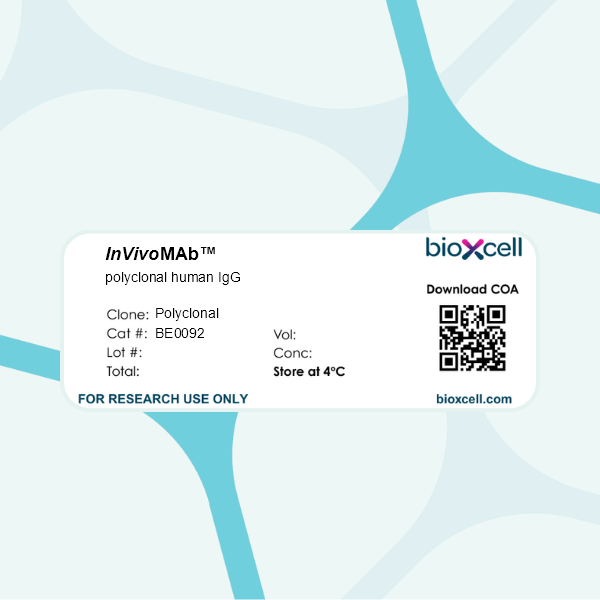
InVivoMAb polyclonal human IgG
Product Description
Specifications
| Isotype | Human IgG |
|---|---|
| Recommended Dilution Buffer | InVivoPure pH 7.0 Dilution Buffer |
| Conjugation | This product is unconjugated. Conjugation is available via our Antibody Conjugation Services. |
| Formulation |
PBS, pH 7.0 Contains no stabilizers or preservatives |
| Endotoxin |
≤1EU/mg (≤0.001EU/μg) Determined by LAL assay |
| Purity |
≥95% Determined by SDS-PAGE |
| Sterility | 0.2 µm filtration |
| Purification | Protein A |
| RRID | AB_1107779 |
| Molecular Weight | 150 kDa |
| Human Pathogen Test Results |
Hepatitis B Surface Antigen: Negative Hepatitis B Core Antigen antibodies: Negative Human Immunodeficiency Virus 1: Negative Human Immunodeficiency Virus 2: Negative Hepatitis C Virus antibodies: Negative * These tests cannot guarantee the absence of infective agents |
| Storage | The antibody solution should be stored at the stock concentration at 4°C. Do not freeze. |
| Need a Custom Formulation? | See All Antibody Customization Options |
Application References
Thura, M., et al (2016). "PRL3-zumab, a first-in-class humanized antibody for cancer therapy" JCI Insight 1(9): e87607.
PubMed
Novel, tumor-specific drugs are urgently needed for a breakthrough in cancer therapy. Herein, we generated a first-in-class humanized antibody (PRL3-zumab) against PRL-3, an intracellular tumor-associated phosphatase upregulated in multiple human cancers, for unconventional cancer immunotherapies. We focused on gastric cancer (GC), wherein elevated PRL-3 mRNA levels significantly correlated with shortened overall survival of GC patients. PRL-3 protein was overexpressed in 85% of fresh-frozen clinical gastric tumor samples examined but not in patient-matched normal gastric tissues. Using human GC cell lines, we demonstrated that PRL3-zumab specifically blocked PRL-3(+), but not PRL-3(-), orthotopic gastric tumors. In this setting, PRL3-zumab had better therapeutic efficacy as a monotherapy, rather than simultaneous combination with 5-fluorouracil or 5-fluorouracil alone. PRL3-zumab could also prevent PRL-3(+) tumor recurrence. Mechanistically, we found that intracellular PRL-3 antigens could be externalized to become “extracellular oncotargets” that serve as bait for PRL3-zumab binding to potentially bridge and recruit immunocytes into tumor microenvironments for killing effects on cancer cells. In summary, our results document a comprehensive cancer therapeutic approach to specific antibody-targeted therapy against the PRL-3 oncotarget as a case study for developing antibodies against other intracellular targets in drug discovery.
Thura, M., et al (2016). "PRL3-zumab, a first-in-class humanized antibody for cancer therapy" JCI Insight 1(9): e87607.
PubMed
Novel, tumor-specific drugs are urgently needed for a breakthrough in cancer therapy. Herein, we generated a first-in-class humanized antibody (PRL3-zumab) against PRL-3, an intracellular tumor-associated phosphatase upregulated in multiple human cancers, for unconventional cancer immunotherapies. We focused on gastric cancer (GC), wherein elevated PRL-3 mRNA levels significantly correlated with shortened overall survival of GC patients. PRL-3 protein was overexpressed in 85% of fresh-frozen clinical gastric tumor samples examined but not in patient-matched normal gastric tissues. Using human GC cell lines, we demonstrated that PRL3-zumab specifically blocked PRL-3(+), but not PRL-3(-), orthotopic gastric tumors. In this setting, PRL3-zumab had better therapeutic efficacy as a monotherapy, rather than simultaneous combination with 5-fluorouracil or 5-fluorouracil alone. PRL3-zumab could also prevent PRL-3(+) tumor recurrence. Mechanistically, we found that intracellular PRL-3 antigens could be externalized to become “extracellular oncotargets” that serve as bait for PRL3-zumab binding to potentially bridge and recruit immunocytes into tumor microenvironments for killing effects on cancer cells. In summary, our results document a comprehensive cancer therapeutic approach to specific antibody-targeted therapy against the PRL-3 oncotarget as a case study for developing antibodies against other intracellular targets in drug discovery.
Thura, M., et al (2016). "PRL3-zumab, a first-in-class humanized antibody for cancer therapy" JCI Insight 1(9): e87607.
PubMed
Novel, tumor-specific drugs are urgently needed for a breakthrough in cancer therapy. Herein, we generated a first-in-class humanized antibody (PRL3-zumab) against PRL-3, an intracellular tumor-associated phosphatase upregulated in multiple human cancers, for unconventional cancer immunotherapies. We focused on gastric cancer (GC), wherein elevated PRL-3 mRNA levels significantly correlated with shortened overall survival of GC patients. PRL-3 protein was overexpressed in 85% of fresh-frozen clinical gastric tumor samples examined but not in patient-matched normal gastric tissues. Using human GC cell lines, we demonstrated that PRL3-zumab specifically blocked PRL-3(+), but not PRL-3(-), orthotopic gastric tumors. In this setting, PRL3-zumab had better therapeutic efficacy as a monotherapy, rather than simultaneous combination with 5-fluorouracil or 5-fluorouracil alone. PRL3-zumab could also prevent PRL-3(+) tumor recurrence. Mechanistically, we found that intracellular PRL-3 antigens could be externalized to become “extracellular oncotargets” that serve as bait for PRL3-zumab binding to potentially bridge and recruit immunocytes into tumor microenvironments for killing effects on cancer cells. In summary, our results document a comprehensive cancer therapeutic approach to specific antibody-targeted therapy against the PRL-3 oncotarget as a case study for developing antibodies against other intracellular targets in drug discovery.
Product Citations
-
-
Cancer Research
-
Immunology and Microbiology
-
Neuroscience
TIMP1 Mediates Astrocyte-Dependent Local Immunosuppression in Brain Metastasis Acting on Infiltrating CD8+ T Cells.
In Cancer Discov on 13 January 2025 by Priego, N., de Pablos-Aragoneses, A., et al.
PubMed
Immunotherapies against brain metastases have shown clinical benefits when applied to asymptomatic patients, but they are largely ineffective in symptomatic cases for unknown reasons. Here, we dissect the heterogeneity in metastasis-associated astrocytes using single-cell RNA sequencing and report a population that blocks the antitumoral activity of infiltrating T cells. This protumoral activity is mediated by the secretion of tissue inhibitor of metalloproteinase-1 (TIMP1) from a cluster of pSTAT3+ astrocytes that acts on CD63+ CD8+ T cells to modulate their function. Using genetic and pharmacologic approaches in mouse and human brain metastasis models, we demonstrate that combining immune checkpoint blockade antibodies with the inhibition of astrocyte-mediated local immunosuppression may benefit patients with symptomatic brain metastases. We further reveal that the presence of tissue inhibitor of metalloproteinase-1 in liquid biopsies provides a biomarker to select patients for this combined immunotherapy. Overall, our findings demonstrate an unexpected immunomodulatory role for astrocytes in brain metastases with clinical implications. Significance: This study presents a significant advancement in understanding immune modulation in brain tumors and offers new insights into the potential therapeutic interventions for brain metastases. See related commentary by Lorger and James, p. 11.
-
-
-
COVID-19
-
Immunology and Microbiology
Optimized ACE2 decoys neutralize antibody-resistant SARS-CoV-2 variants through functional receptor mimicry and treat infection in vivo.
In Sci Adv on 9 December 2022 by Torchia, J. A., Tavares, A. H., et al.
PubMed
As severe acute respiratory syndrome coronavirus-2 (SARS-CoV-2) evolves to escape natural antibodies, it also loses sensitivity to therapeutic antibody drugs. By contrast, evolution selects for binding to ACE2, the cell-surface receptor required for SARS-CoV-2 infection. Consistent with this, we find that an ACE2 decoy neutralizes antibody-resistant variants, including Omicron, with no loss in potency. To identify design features necessary for in vivo activity, we compare several enzymatically inactive, Fc effector-silenced ACE2-Fc decoys. Inclusion of the ACE2 collectrin-like domain not only improves affinity for the S protein but also unexpectedly extends serum half-life and is necessary to reduce disease severity and viral titer in Syrian hamsters. Fc effector function is not required. The activity of ACE2 decoy receptors is due, in part, to their ability to trigger an irreversible structural change in the viral S protein. Our studies provide a new understanding of how ACE2 decoys function and support their development as therapeutics to treat ACE2-dependent coronaviruses.
-
-
-
Cancer Research
-
Cell Biology
-
Immunology and Microbiology
-
In vivo experiments
Ablation of the endoplasmic reticulum stress kinase PERK induces paraptosis and type I interferon to promote anti-tumor T cell responses.
In Cancer Cell on 10 October 2022 by Mandula, J. K., Chang, S., et al.
PubMed
Activation of unfolded protein responses (UPRs) in cancer cells undergoing endoplasmic reticulum (ER) stress promotes survival. However, how UPR in tumor cells impacts anti-tumor immune responses remains poorly described. Here, we investigate the role of the UPR mediator pancreatic ER kinase (PKR)-like ER kinase (PERK) in cancer cells in the modulation of anti-tumor immunity. Deletion of PERK in cancer cells or pharmacological inhibition of PERK in melanoma-bearing mice incites robust activation of anti-tumor T cell immunity and attenuates tumor growth. PERK elimination in ER-stressed malignant cells triggers SEC61β-induced paraptosis, thereby promoting immunogenic cell death (ICD) and systemic anti-tumor responses. ICD induction in PERK-ablated tumors stimulates type I interferon production in dendritic cells (DCs), which primes CCR2-dependent tumor trafficking of common-monocytic precursors and their intra-tumor commitment into monocytic-lineage inflammatory Ly6C+CD103+ DCs. These findings identify how tumor cell-derived PERK promotes immune evasion and highlight the potential of PERK-targeting therapies in cancer immunotherapy.
-
-
-
Cancer Research
Activation of Tumor-Cell STING Primes NK-Cell Therapy.
In Cancer Immunol Res on 3 August 2022 by Knelson, E. H., Ivanova, E. V., et al.
PubMed
Activation of the stimulator of interferon genes (STING) pathway promotes antitumor immunity but STING agonists have yet to achieve clinical success. Increased understanding of the mechanism of action of STING agonists in human tumors is key to developing therapeutic combinations that activate effective innate antitumor immunity. Here, we report that malignant pleural mesothelioma cells robustly express STING and are responsive to STING agonist treatment ex vivo. Using dynamic single-cell RNA sequencing of explants treated with a STING agonist, we observed CXCR3 chemokine activation primarily in tumor cells and cancer-associated fibroblasts, as well as T-cell cytotoxicity. In contrast, primary natural killer (NK) cells resisted STING agonist-induced cytotoxicity. STING agonists enhanced migration and killing of NK cells and mesothelin-targeted chimeric antigen receptor (CAR)-NK cells, improving therapeutic activity in patient-derived organotypic tumor spheroids. These studies reveal the fundamental importance of using human tumor samples to assess innate and cellular immune therapies. By functionally profiling mesothelioma tumor explants with elevated STING expression in tumor cells, we uncovered distinct consequences of STING agonist treatment in humans that support testing combining STING agonists with NK and CAR-NK cell therapies.
-
-
-
Immunology and Microbiology
Direct and indirect immune effects of CMP-001, a virus-like particle containing a TLR9 agonist.
In J Immunother Cancer on 1 June 2021 by Sabree, S., Voigt, A. P., et al.
PubMed
CMP-001, also known as vidutolimod, is a virus-like particle containing a TLR9 agonist that is showing promise in early clinical trials. Our group previously demonstrated that the immunostimulatory effects of CMP-001 are dependent on an anti-Qβ antibody response which results in opsonization of CMP-001 and uptake by plasmacytoid dendritic cells (pDCs) that then produce interferon (IFN)-α. IFN-α then leads to an antitumor T-cell response that is responsible for the in vivo efficacy of CMP-001. Here, we explore mechanisms by which the initial effects of CMP-001 on pDCs activate other cells that can contribute to development of an antitumor T-cell response.
-
-
-
In vivo experiments
-
In vivo experiments
-
Cancer Research
PRL3-zumab, a first-in-class humanized antibody for cancer therapy.
In JCI Insight on 16 June 2016 by Thura, M., Al-Aidaroos, A. Q. O., et al.
PubMed
Novel, tumor-specific drugs are urgently needed for a breakthrough in cancer therapy. Herein, we generated a first-in-class humanized antibody (PRL3-zumab) against PRL-3, an intracellular tumor-associated phosphatase upregulated in multiple human cancers, for unconventional cancer immunotherapies. We focused on gastric cancer (GC), wherein elevated PRL-3 mRNA levels significantly correlated with shortened overall survival of GC patients. PRL-3 protein was overexpressed in 85% of fresh-frozen clinical gastric tumor samples examined but not in patient-matched normal gastric tissues. Using human GC cell lines, we demonstrated that PRL3-zumab specifically blocked PRL-3+, but not PRL-3-, orthotopic gastric tumors. In this setting, PRL3-zumab had better therapeutic efficacy as a monotherapy, rather than simultaneous combination with 5-fluorouracil or 5-fluorouracil alone. PRL3-zumab could also prevent PRL-3+ tumor recurrence. Mechanistically, we found that intracellular PRL-3 antigens could be externalized to become "extracellular oncotargets" that serve as bait for PRL3-zumab binding to potentially bridge and recruit immunocytes into tumor microenvironments for killing effects on cancer cells. In summary, our results document a comprehensive cancer therapeutic approach to specific antibody-targeted therapy against the PRL-3 oncotarget as a case study for developing antibodies against other intracellular targets in drug discovery.
-